Lemongrass Beef Stirfry
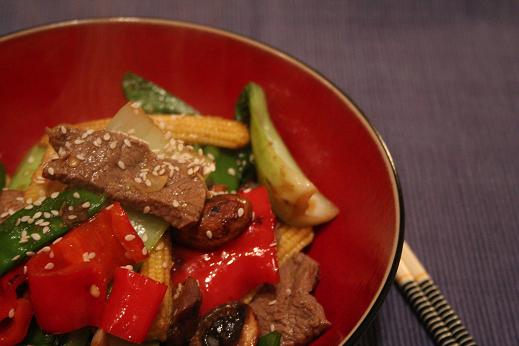
We’ve been rather fond of grilled marinated lemongrass beef in the past and today we decided to try including marinated lemongrass beef in a stir fry and we were pleasantly surprised at how well it worked.
We mashed up two thirds of a stalk of lemongrass in the mortar and pestle with a clove of garlic. zest of half a lime and half a chilli then added a tablespoon or so each of lime juice, soy sauce and Thai fish sauce with a splash of sesame oil. We sliced up a sirloin steak into short strips and marinated it in this mixture for about half an hour. When this was done, we stir fried the steak in a wok until it was just done. Emptied the steak onto a wok and then stir fried our vegetables. The vegetables we used were red pepper, mange tout, baby corn, mushrooms and pak choi. We added a tablespoon or so of soy sauce, fish sauce and rice wine to the vegetables while they were cooking and when they were done, we added the beef back into the wok, mixed it all up and then served it. Served with some jasmine rice, it was delicious.


Japanese Scallops

Having been to Bincho Yakitori last week and had many very, very delicious Japanese style bits of meat and fish on sticks, we decided to try our own. We tried with scallops and marinated them in soy, honey, sake and a little oil. We lacked a charcoal grill, so cooked them in a frying pan. They were tasty but nowhere near as tasty as those we’d had last week which are definitely something to aspire to. Served with a simple mixed vegetable stir fry.
Cool Stuff

Today was pretty difficult to get excited about, it was dark when I woke up, it was raining and of course, it was Monday. I would have preferred to stay at home in my pyjamas but I did the right thing and went to work.
Imagine my delight when I got there to be presented with these two exciting packages – some cool chocolates and some roasted broad beans which friends of ours bought us from Oriental City. Stephen and I have resolved to visit next weekend so we can see what else is on offer – we currently have chopstick rests and a bamboo steamer on our list.
I’m trying to wait until Stephen comes home to open up the beans and the chocolate but I’m not sure how long I’m going to survive!
Rocket Pesto
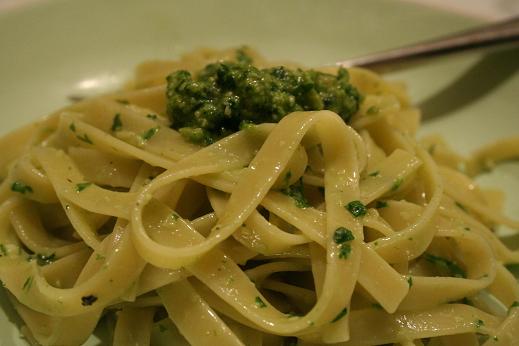
I wasn’t sure what to eat tonight, Stephen is out and usually when I cook something just for myself it turns out badly. I spent a while looking for easy pasta dishes but didn’t find anything that excited me so I decided on cheese on toast, my usual cooking-for-one standby. On the way home though I started thinking about how yesterday was our one year anniversary and cheese on toast was a bit lame for our one-year-and-one-day anniversary so I decided I’d make pesto.
Stephen and I attempted pesto once before but it was a huge pain without a food processor and the end result was inedible anyway, far too garlicky and completely over-powering. Now we have the new Magimix though I thought I’d give it another go. There was no basil in the shop so I bought rocket instead and resolved to use a lot less garlic than last time.
I got home, checked a few recipes online for quantities and decided on:
100g rocket
60g pine nuts
60g parmesan
100ml oil
1 garlic clove (the recipes I looked at ranged from none to three)
So I got out the Magimix and got to work. Except the Magimix didn’t seem to want to work. After twenty minutes of changing blades and pulsing and chopping I finally gave in, threw a few things around the kitchen and got out the trusty mortar and pestle. The whole thing ended up taking about half an hour (instead of the predicted five minutes) but it was worth it. The resulting pesto was creamy, not too finely chopped and had a peppery and not too garlicky flavour.
Now I just have to wash up all the pieces of the Magimix and the various bowls, spoons, spatulas and mortars and pestles I used trying to create this quick and easy supper.
Happy Blogday
It’s one year today since Dinner Diary went live. Stephen and I had the idea for a food blog a while before that but were stuck on a focus and a name. I’m not sure in which order those two things were decided (I have a vague memory of the two of us shouting possible names to each other across the lounge after we’d drunk quite a lot of wine, Dinner Diary was MY idea though 🙂 ) but once they were sorted we quickly set about registering our domain name and creating our first post.
Initially we both wondered if it might be a fad but we soon got used to eating cold food while we wrangled with the poor lighting in our North London flat and embraced the opportunity to buy new dishes and plates; the essential elements of food blogging 🙂 We quickly found that dinner time became an opportunity to cook something new and interesting instead of relying on our old favourites and we both spent a lot more time trawling the web for recipes and obsessively snipping articles from magazines.
We’ve both been interested in food for a long time and have always spent most weekends and many evenings cooking but Dinner Diary gave us the push we needed when we got home from work late and tired and didn’t feel like cooking – if we ate cheese on toast every night then it wouldn’t make very interesting reading.
We decided early on that we wouldn’t be selective with our postings, we’d photograph everything and be honest about how it tasted so, when we spent all day Saturday laying in the sun drinking Pimms and only ate crisps for dinner we posted it. Last Thursday when I was hungover, home alone and too lazy to even slice some cheese for a sandwich I ate a supermarket pizza. It was horrible but I posted it anyway.
Aside from the cold food the blogging benefits far outweigh the negatives, I’ve already mentioned all the shopping we’ve had to do so that the photographs look good but there’s also the opportunity to eat interesting food. No-one wants to read page after page of sausages and mashed potatoes or fish and new potatoes so we try to be creative although it has been noted that we eat a lot of chicken!
Which leads me nicely into one of the negatives: it’s very difficult not to over-eat when you’re cooking interesting, creative food every day. The recipes that interest us the most tend to be the ones with a lot of butter or oil or carbohydrates – pasta, risotto, casseroles and stews – none of which are particularly good for the waistline. Hence the chicken. It’s our quiet nod to healthy eating and of course, it’s reasonably priced and versatile. As much as we’d love to eat rib of beef and langoustines every night because they’re interesting and look good our budget (and our waistlines!) doesn’t stretch that far.
A lot of food bloggers write posts about themselves which is not something Stephen and I have ever done (Stephen and Kerri are not our real names in case you were wondering!), apart from the “we like food and we like taking pictures of food” strapline that we have on our homepage. It seems to say it all though. We do like food and we do like taking photos of food. We did toy with the idea of publishing a photo of ourselves along with a longer biography but we decided against it, both of us are quite attached to our pseudonyms now*.
One of the original reasons for starting Dinner Diary was so that we would have a record of the food we’d eaten and an online repository for storing our recipes, I don’t think we even told anyone apart from our close friends what we doing for the first four of five months. The food record and recipe repository is still one of the most useful things about Dinner Diary for us, we both use it constantly to find our recipes and look for inspiration. Accidentally clicking on one of our favourites like Roast Chicken when there’s two hours before lunch can be painful though.
Having said that, reading the comments left by people is a great thing. It’s still really exciting to log on and see “comment in moderation” waiting and it’s even more interesting when people we don’t “know†leave us a comment although that often leads us to wonder how they found us. We recently added a traffic analyser which is really interesting…we found that “too much chilli†was one of the search comments that led people to us, as was “sluttyâ€. The analyser told us that we get on average 846 hits per day, I think we might need a new analyser…!
I’m confident that we’ll keep going for another year, it’s complete natural for us now to have the camera in the kitchen while we’re cooking and without thinking we both usually have an idea in our heads about how the dish is going to look when finished. Being able to look back at what you’ve eaten over the last year is a brilliant thing too, as is having a permanent, central place to keep your recipes.
In honour of our first anniversary, we cooked game pie today. Game casserole was one of the first dinners to appear on Dinner Diary so it seemed fitting. I got us a new placemat too 🙂


*Stephen and Kerri are our real names, we wrote this when we were still known as Fred and Ginger. Most of that paragraph is irrelevant now but I’ll leave it there for posterity. Thanks, Ethel 🙂
Mackerel Pate
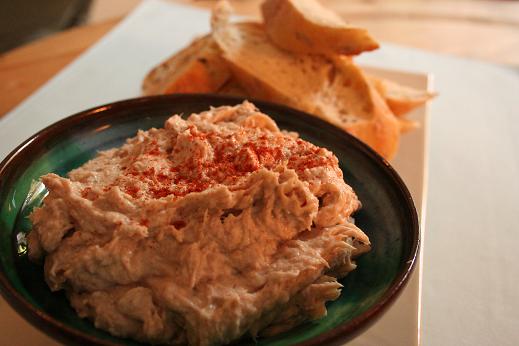
At last! This has been on my “Things To Cook Soon” list for months. We both love smoked mackerel and eat it a lot, we also eat a lot of mackerel pate but never seem to get round to making it ourselves for some reason. Today though we rectified that and I’m glad we did because it was really tasty. And quick to make too thanks to the new Magimix. The mackerel was pulsed in the mixer before some cream cheese was added, salt and cayenne went in next along with some lemon juice. A final blitz and it was ready.
Sea Bass with Fennel and Lemon

Last night Kerri was out, so I was just cooking for myself. I decided on some sort of fish with fennel and found a recipe that included lemons too. Armed with a wild sea bass, one large fennel bulb, a few small fennel bulbs and a lemon, I went to work. I chopped up the tops of the fennel and stuffed the fish with them. Then I sliced the bulbs in half and fried them in a hot frying pan until they were slightly charred. I did the same with the lemon and then put the fish into an oven dish with the fennel and lemon and roasted it until it was done.
The bass was good and I enjoyed the fennel but not much of the lemony flavour made it into the fish. So I squeezed some lemon juice over the fish, which came out a rather brownish colour due to the charring.
With (and before) it I drank a Grüner Veltliner from Austria (most of it is from Austria), which complemented it rather well.
Foodie Blogroll
We’ve joined the Foodie Blogroll – a huge list of food blogs check it out here.
Pizza…
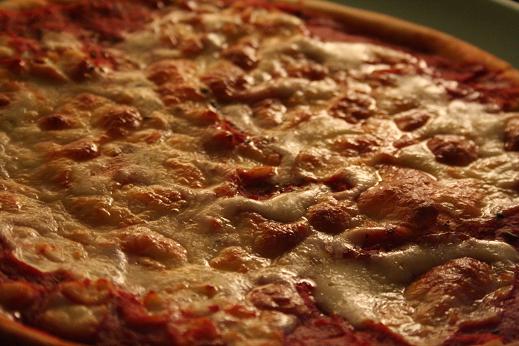
…from the supermarket. They were mean with the cheese, the tomato sauce tasted like tomato puree and the base was soggy. Don’t try this at home.
Chicken Casserole
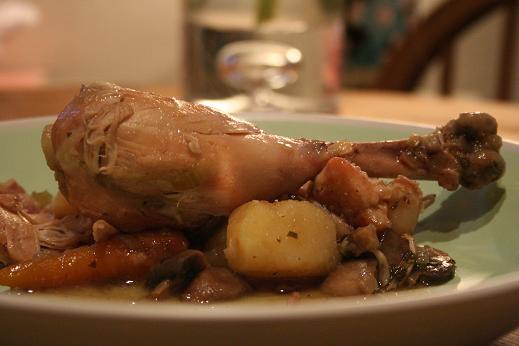
Yesterday Kerri made chicken casserole with stock that we’d made on Saturday. Today we reheated it and had it for dinner and it was really good. It had a lovely depth of very chickeny flavour and it was just the thing to have on a rather chilly evening. Winter appears to be arriving and we might have to make more of this sort of thing out of necessity.
This is Kerri’s recipe, adapted from a few sources and tailored to what we like:
Chicken Casserole
Serves four
2lb chicken pieces with bones
2 tablespoons flour
Salt and pepper
Oil
125g lardons
2 medium onions, finely chopped
3 garlic cloves, crushed
One large carrot, chunked
225g mushrooms, chopped
500ml chicken stock
300ml white wine
Sprig thyme, chopped
Six sage leaves, chopped
Bay leaf
Two medium potatoes, chunked
Coat the chicken in the seasoned flour.
Heat oil and brown chicken on all sides – about ten minutes.
Remove the chicken and add more oil if necessary.
Add the bacon, celery, onions, garlic, carrots and mushrooms and saute for five minutes or until the onions are translucent.
Return the chicken to the pan, stir in the excess flour, add the stock, wine and herbs.
Check for seasoning and cook for one hour on a low heat.
Check for seasoning, add diced potato.
Cook for a further hour (without lid if necessary to reduce liquid).
Check for seasoning and serve with extra vegetables and/or bread.
*Chopped parsley will make the water green, add this just before serving
*Shallots could be used instead of onions
