Chilli and Baked Potatoes
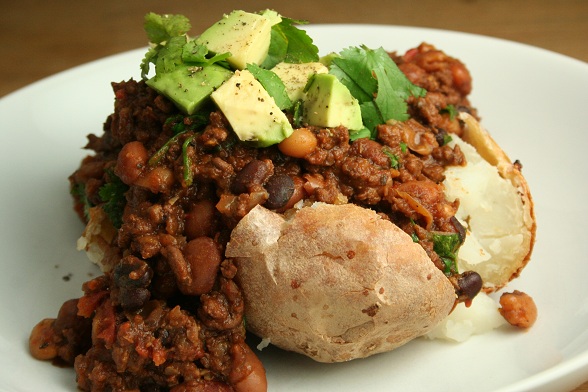
If we have a Saturday at home, we usually like to take the opportunity to cook something new. We were at home today but we had a long list of chores to get through and needed something that would sit happily in the oven while we got on with other things. The other thing is that cooking new things is all well and good but if you spend every spare minute doing that, you never get to eat your old favourites. Chilli with baked potatoes is definitely a favourite, especially in this kind of weather so, early this morning, we got on with this and then left it on a low heat for the rest of the day. It’s definitely better if you can cook it the day before you eat it but the long, slow cooking is not a bad option if you don’t have time for that. And really, who has time to cook chilli on a Friday night when there’s wine to be drunk and end-of-week celebrating to be done?
We mostly followed this recipe, but reduced some of the spicing since last time it was a bit too powerful. We also used beef mince this time and avocado leaves in place of bay leaves since we’ve had some in the cupboard since the last time I went to Borough market and haven’t used them. What they added I’m not sure but at least I won’t feel so guilty about not using them every time I open the cupboard now.
In place of the chilli powder, we used some dried chillies, rehydrated and then blitzed in the food processor with a little water. These are great for adding a sweet, smoky note and are fresher and more alive than the powder (the chipotle chilli powder is really good if you can find it though, we buy ours from Whole Foods or Borough market but you can buy it online too).
The other thing we did differently was to put this in the oven once it had come up to the boil, where we left it for about five hours. The reason we did this is because we needed to go out and didn’t want to leave the gas on. It was a good solution but, even better than that, it gave the chilli a wonderful baked texture that was similar to that of lasagne or cottage pie. Something we’ll definitely do again.
So, what I thought was our perfect chilli con carne recipe seems to have evolved again. I wonder if we’ll ever get it just right or if we’ll continue to play around with the recipe?
Chilli Con Carne
Serves Four
4 tbsp olive oil
1 large green chilli, roasted, deseeded and pulped
1 red chilli, roasted, deseeded and pulped
4 garlic cloves, roasted and then pulped
1 green pepper, charred and then finely chopped
Spice Mix
1 tsp ground cumin
1.5 tsp ground coriander
5 black peppercorns
1 clove
1 tsp chipotle chilli powder (or dried chillies, rehydrated and blitzed to a paste with water)
1.5 tsps ground cinnamon
1 tsp smoked paprika or 1 tsp sweet paprika
1 tsp dried oregano
2 tbsp tomato purée
500g red kidney beans (or any combination of similar sized beans)
500g minced beef
1 large onion, finely chopped
Bay leaf (or avocado leaves)
250ml dark beer
600ml beef stock (plus more boiling water as the sauce cooks, if required)
400g tin chopped tomatoes
1 tblsp Worcestershire sauce
1 tsp cocoa powder
To Serve
Salt
Juice of half a lime
Handful of chopped coriander
Roast the chilli and garlic in the over for about 20 minutes, on 190 degrees, before leaving them to cool down. Remove the seeds from the chilli and squash together with the garlic.
Blacken the pepper on top of the hob (if you have a gas hob, otherwise roast in the oven) and then transfer to a plastic bag to steam for a few minutes. Remove from the bag, skin, deseed and then chop finely.
At the same time, toast the coriander and cumin in a frying pan on a low heat, for about 10 minutes. Once cooled, grind them up with some black pepper and a clove and transfer to a bowl, add the other powdered spices.
In a large pan, brown the meat and remove to a plate. This took about 20 minutes. In the same pan, add some more oil and soften the onions for about five to 10 minutes. Then add the pulped garlic and chilli, the bay leaf and the diced pepper and cook for another five minutes.
Add the powdered spices and cook for a couple of minutes. Add the tomato puree and cook for two minutes. Return the meat to the pan and combine with the spice paste. Deglaze with the beer, then follow with the beans, the rehydrated chillies, stock, tomatoes, a dash of Worcestershire sauce and season with black pepper. Bring to the boil, reduce the heat and then transfer to the oven for five hours on 150 degrees.
Just before the end of the cooking time, add the cocoa powder and cook for another five minutes. Season with salt and serve with a squeeze of lime and a handful of chopped coriander stirred through (if you’re making this the day before then add the lime juice and coriander just before serving).


Jamie’s Sausage Pasta

This recipe comes from Jamie’s new 30 Minute Meals book which we were sent recently. It’s always the pasta recipes that catch my eye when paging through Jamie’s books and, having highlighted this one and with no plans for dinner, it seemed like a good option for a rainy Tuesday night.
I actually saw him cook this on TV recently and I think we followed the recipe quite closely (apart from the addition of some cavolo nero at the end). He mentioned that this is the kind of dish that tastes as if you’ve cooked it for a long time and one of the things that help with that (apart from the browning of the meat) is the addition of the balsamic vinegar. I don’t like balsamic vinegar very much so was slightly worried about using it and, as it turned out, I think we probably added too much.
It was pretty good though, I especially liked the combination of the pork and fennel. Fennel isn’t something I would have thought of adding to a ragu for pasta but it worked well and I’m keen to try something similar again. Just with less balsamic vinegar.
There’s actually quite a few recipes that I like the sound of in this book and I’ve taken it to work and left it on my desk. It seems like just the thing to have around when you don’t have a plan for dinner and need some inspiration before picking stuff up on the way home.
Thai Chicken Noodle Soup

We had a roast chicken on Sunday and, of course, there were leftovers. We normally turn these into chicken curry but I was keen to try this Nigella recipe that I’d seen her make on TV recently. We forgot the vegetables and played around with the recipe (adding lemongrass and fish sauce) and it was okay, but not brilliant. The tamarind and turmeric gave it a pungent, slightly harsh flavour which clashed with the other fragrant notes and it just wasn’t as fresh as I was hoping for. One for the “needs work” category.
Pizza Party

Last Saturday, Stephen’s sister, her husband and their little girl came over for lunch. We thought Stephen’s niece might enjoy making pizza so we made up a huge batch of dough and some tomato sauce and laid out lots of toppings for everyone to choose from.
I’d intended to experiment with a blue cheese and fig pizza but couldn’t resist the salami and mozarella so stuck to those. Stephen’s niece opted for cheddar instead of mozarella and it was a huge hit, reminding me of really good cheese on toast. A combination of that, the mozarella and some blue cheese would have been great but it was too late by the time I realised. Next time.
Piccalilli

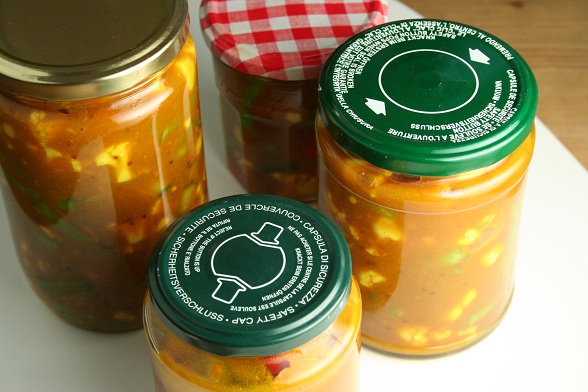
We watched Hugh Fearnley-Whittingstall’s Everyday programme last week and it reminded us that we had planned to make piccalilli this year, in time for Christmas. Since we had a quiet weekend planned, we added the ingredients to our shopping list and made it up on Sunday afternoon. Aside from the overnight salting, it was quick and easy to make and it’s now sitting happily in our pantry (I wish, when I say pantry, I mean tiny, over-stuffed food cupboard) maturing where it will need to stay for about six weeks.
Like the sloe gin and sloe chutney we made a couple of weeks ago, we don’t know yet what this is going to taste like. The recipe made three large jars with a small amount leftover which we put into a smaller jam jar. This is the perfect tasting size and can be cracked open ahead of Boxing Day for a taste test. Of course, by that time, it will be too late to tinker with the flavours so we’ll just have to keep our fingers crossed.
Piccalilli
1kg vegetables – cauliflower, radish, green beans, cucumbers, shallots
50g salt
30g cornflour
10g ground turmeric
10g English mustard powder
10g ground ginger
1/2 tbsp yellow mustard seeds
1/2 tsp crushed cumin seeds
1 tsp crushed coriander seeds
500ml cider vinegar
150g granulated sugar
50g honey
Cut the vegetables into small pieces. Place in a large colander over a bowl, and sprinkle with the salt. Mix well, cover with a tea towel and leave in a cool place for 24 hours, then rinse the vegetables in water and drain thoroughly.
Blend the cornflour, turmeric, mustard powder, ginger, mustard seeds, cumin and coriander to a smooth paste with a little of the vinegar. Put the rest of the vinegar into a saucepan with the sugar and honey and bring to the boil. Pour a little of the hot vinegar over the blended spice paste, stir well and return to the pan. Bring gently to the boil. Boil for 3-4 minutes to allow the spices to release their flavours into the thickening sauce.
Remove the pan from the heat and carefully fold the well-drained vegetables into the hot, spicy sauce. Pack the pickle into warm, sterilised jars and seal immediately with vinegar-proof lids. Leave for about 6 weeks before opening. Use within a year.
Recipe from Hugh Fearnley Whittingstall’s Everyday book (according to the channel four website, I have the book and couldn’t find the recipe though).
Cavolo Nero Pasta
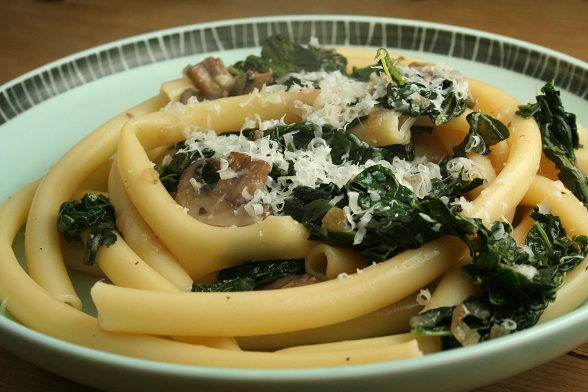
Another week without any posts. This is becoming embarassing. And, as is usual when this happens, there isn’t anything particularly worth waiting for.
This had potential but I can’t quite remember what that potential was since it was so long ago that we ate it. There was chilli, garlic and anchovies in here, along with some mushrooms and some cavolo nero. And that odd looking pasta that, while tasty, was impossible to eat.
This is our second attempt at using cavolo nero in a pasta dish and it was much better than last time. I think I just need to stop trying to be healthy and throw a load of salami and mozarella at it. And write it up more quickly so I can remember what I did and what I need to do next time.
Raan

This is something Stephen has been wanting to cook for a while. I hadn’t heard of it until recently and I don’t recall hearing him mention it either but my knowedge of Indian dishes is very small and I have a very bad memory so this isn’t unusual. I first heard about it a little while ago when a friend told us his mum used to cook it on special occasions during the seventies. I couldn’t find a lot of information online when I was searching for a recipe but it did strike me as being something of a celebratory dish, simply because of the time and effort required to mix up the spices and leave the meat to marinate. It’s not something you’d have time to do after work anyway.
We marinated our lamb leg overnight, as per this recipe, but I saw several other recipes that suggested a two-step marinade: dry spices for 24 hours followed by the wet marinade for another 24 hours.
Like a lot of slow-cooked dishes, once you’ve made up the spice mixes and done the marinating, the meat then sits happily in the oven leaving you time to get on with other things. This is one of my favourite ways of cooking, especially on a Sunday when there are so many other things that need to be done. Once we’d finished all our weekend chores, we sat down to the raan which we served with chapatis, dal and spiced cauliflower.
The long, slow cooking meant that the flavours of the spices melded together perfectly with no one flavour overpowering the other. Not too hot but with a good kick and plenty of fragrant notes to lift the rounded, earthy flavours.
Our sauce had dried out quite a lot which I really liked, all those sticky, pan-edge pieces that are crispy and chewy at the same time. It would have been nice to have a little more liquid though.

Sloe Gin and Sloe Chutney

A couple of weeks ago, we went sloe picking with a friend. He has a spot that he visits every year which generally provides him with a plentiful haul and we’ve been meaning to go with him for a while. This year, since it was such a nice day, he thought he would take us somewhere new which he suspected might provide good pickings.
We started off slowly, picking individual berries from small bushes along the path until, out of the corner of his eye and across a field, our friend spied a bigger bush. When we reached said bush we realised it was surrounded by many other, even bigger bushes, heaving with sloes. We started to pick and soon realised that we need not have worried earlier about being greedy and stripping the bushes since there were huge amounts of berries available. We stopped after filling a couple of bags each and came home to find we had seven kilos between us.
It was late so the berries were squeezed into our tiny fridge and left until the next day when we began the long process of washing and de-stalking the berries. Back into the fridge again until the next evening when we had enough time to start turning them into something interesting.
We started off with a traditional sloe-gin and a traditional vodka. Since we had so many berries we also decided to experiment and make two smaller bottles of gin flavoured with almonds, lemon peel, cloves and cinnamon.
And then, since there were still so many berries left, we made a chutney.
Of course, we don’t know what anything tastes like yet since the gin needs to be left for at least six months and the chutney . I suppose that’s all part of the fun though.

Sloe Gin (or vodka)
600g sloe berries
250g sugar
1 litre gin or vodka
Wash and de-stalk the berries. Add to a sterilised jar with the sugar and shake vigorously. Traditional methods state that you should prick each individual berry (with a hawthorn if you’re being really traditional) to bruise the fruit and let out some juice. We figured the muddling method would work just as well though and life really is too short to prick seven kilos of sloes.
Top up with gin, mix and seal the jar.
Turn daily for a week and then weekly for a month. Store in a dark place for three months, or ideally, until next year.
Spicy Sloe Gin
600g sloe berries
250g sugar
1 litre gin or vodka
2 inch piece cinnamon
Small handful slivered almonds
2 cloves
2 strips lemon zest
Prepare as per above, adding the aromatics alongside the alcohol.
Sloe Chutney
1 kilo sloe berried
2 tart apples, peeled, cored and chopped
2 medium sized onions, sliced
1lb raisins
1 teaspoon of hot chilli powder
2 inch piece of fresh root ginger, grated
1 garlic clove, crushed
1 teaspoon salt
1/2 teaspoon grated nutmeg
12 cloves
Juice and grated rind of 2 oranges
1lb of soft brown sugar
1 pint white wine vinegar
Put the ingredients in a large cooking pot and stir, using a wooden spoon. Bring to the boil and stir occasionally. Reduce the heat so the mixture simmers and stir occasionally, for 3 hours or until it is thick. Ladle into clean, warm jars. Cover, label and leave in a cool place for a couple of months.
Recipe from the River Cottage forum.
Eggs with Bubble and Squeak
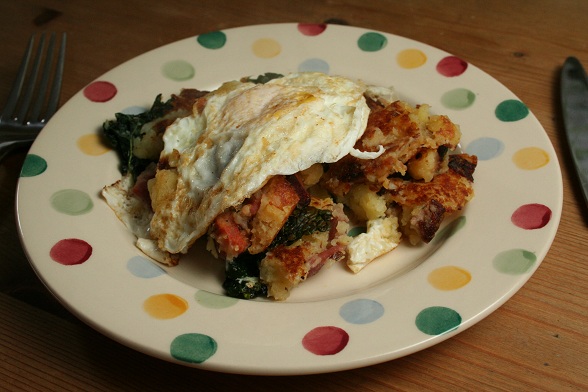
Stephen’s at they gym at the moment. It’s not unusual for him to be at the gym, he goes regularly but not usually on a Sunday morning. Sunday mornings are usually reserved for leisurely breakfasts and lunch preperation. The reason for this unusual burst of activity? That’s what he had for breakfast this morning.
Stephen loves eggs and often eats them for breakfast at the weekend, usually fried or scrambled on toast but if there’s anything lurking in the fridge that can be fried up and served alongside then it will be. Today however we were in the unusual position of having more than just potatoes and vegetables left over, there was also some pork fillet, a little jamon and some chorizo so that all went into the frying pan alongside some cavolo nero and some mashed potato to make a porky bubble and squeak. A pretty good way to start the day, even if it does guilt you into an additional gym visit.
Home Made Tapas
Saturday night! As we weren’t going out, that meant that it was time to cook something “interesting”. Where the exact meaning of “interesting” does of course vary depending on what mood we are in, but generally cooking on a Saturday means that there is more time available to prepare, so the range of what can be achieved without consequently eating at midnight is therefore greater.
As it turned out, most of what we ended up cooking this time round was relatively quick to prepare, but there was a range of it so that meant that it was still “interesting”: a range of small tapas-like dishes, mostly from the Moro cookbook. It did turn out to be something of a game of two halves though; more on that later. So, armed with a glass of Manzanilla, we set about preparing. First up was Chorizo in sherry. Very simple: Fry some chorizo and then splash some Fino (we used Manzanilla as that is what we had) over it. Tasty and chorizoey as it should be, with a light tang from the sherry but that mostly gets lost in the paprika-flavoured chorizo oil.

Next was clams in Manzanilla (we stuck to the recipe properly here, which was the reason we had Manzanilla at hand). Again, very quick but not quite as dead simple as the chorizo: Fry some thinly sliced garlic in olive oil. When it starts to brown, add the clams, manzanilla and some chopped parsley. After a few minutes, when the clams have opened, add some more chopped parsley and some black pepper and serve with a lemon wedge to squeeze over the clams if the fancy takes you. We ate them with some bread made from left-over pizza dough from last night, which was great to soak up the clam-and-Manzanilla-and-parsley sauce. The clams themselves were very good too; this was our favourite dish of the evening, which was good because at the last minute we had realised that we didn’t have any clams and had made a special trip to buy some.

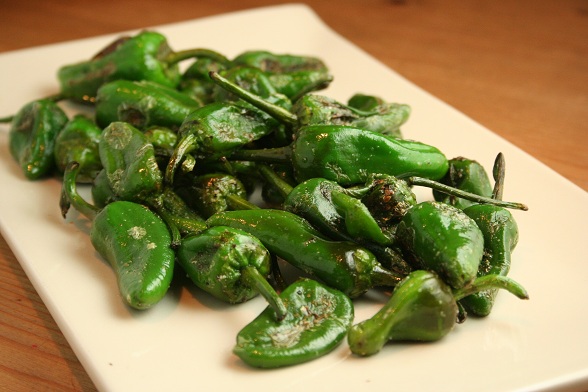
We had had a bag of Padron peppers in the fridge for a while and this seemed like a perfect opportunity to use them up. Tossed in oil and salt, then fried until starting to blister, they came out looking good. But didn’t taste good as they were too old and some were going brown inside; clearly been in the fridge for too long. So we didn’t eat them, which was a shame as we had been planning to serve pork skewers on top of them. Remember I said this was a meal of two halves? This was the beginning of the not-so-good half.
Griddled chicory served with jamon and a sherry vinegar and thyme dressing sounded like a good combination and it mostly worked well: the bitter crunch of the chicory complemented the soft, salty jamon and the sweet and sour dressing. Kerri wasn’t a fan of the dressing though, finding it too sweet and cloying.

Finally onto the Moorish skewers, which were initially due to be served on top of the Padron peppers in the way that we had had lamb chops served on Padron peppers in a tapas restaurant. Seeing the recipe in the book, they looked familiar but we couldn’t remember if we had actualy cooked them before or not. Turned out that we had, and the reason that we couldn’t remember very well was that it was three years ago! This was the only part of the meal that required advance preparation – grinding up spices and marinating the meat in them for two hours before cooking – recipe for this at the end of the post.
Our original intention had been to barbecue these because the weather forecast had looked really good, but when the actual weather arrived it clearly hadn’t read the forecast because it wasn’t as good as we had hoped for. So we did these under the grill in our oven. The grill in our oven is really rubbish, It heats up and then turns itself off for a while and then heats up again. When I grill something I want constant, blasting heat, as if it was on a barbecue. Not some sort of thermostat-controlled namby pamby grill that means that by the time you have any sort of char on the outside of your meat you have completely overcooked it and dried it out. In fact we had to put the skewers in a frying pan eventually to try to get some char on them.
The spicy marinade gave the pork a lovely flavour, but they were dried out as you probably gathered from my rant. We made a comment on that previous post about using less saffron next time. We hadn’t read it, but ended up using less saffron purely because we didn’t have much left. Which worked out well.

Ingredients:
1 pork fillet of 500g, trimmed of fat and sinew
sea salt and black pepper
1/2 heaped teaspoon each of coriander seeds, cumin seeds and fennel seeds, all roughly ground
1 teaspoon sweet smoked Spanish paprika
2 garlic cloves, crushed to a paste with salt
a good pinch saffron (about 60 strands) infuxed in 2 tablespoons of boiling water (we used less than half of this this time round)
1/2 small bunch fresh oregano roughly chopped or 1 teaspoon dried oregano
1 bay leaf, prefereably fresh, crumbled or chopped very finely
1 dessertspoon red wine vinegar
1 dessertspoon olive oil
Cut the pork fillet in half lengthways and then into 3cm cubes. Flatten these cubes slightly. (We didn’t cut it in half and just sliced it into thinnish round slices, didn’t need to flatten them) Place the pork in a large mixing bowl and add the marinade dry spices, garlic, saffron-infused water, oregano, bay and vinegar and mix thoroughly. Then add the olive oil, toss again and leave in the fridge for 2 hours so the flavours or the marinade get into the meat.
Thread onto skewers (remember to soak them beforehand if you are using wooden ones) and cook over high heat, on a barbecue or griddle pan or under a decent grill (not like ours). Enjoy!
